Showing posts with label social networking. Show all posts

Monday, January 23, 2012

Death Wishes via Twitter

As a Giants fan, yesterday was a good day. The 49ers played a great game, but in the end, a few mistakes by a player pushed in to an unfamiliar role did them in.

The last time the Giants and 49ers faced each other in the playoffs (2003) the same sort of thing happened. A player named Trey Junkin was signed out of retirement to snap the ball for field goal attempts. He messed up a snap earlier in the game, and at the end of the game, he messed up another field goal snap and the Giants lost the game. Junkin faded away in to relative anonymity, though he had to read about the Giants in the newspapers.

In last night's game, a young player named Kyle Williams was pushed in to the role of punt returner because of an injury to the player who regularly filled that role, Ted Ginn Jr. Williams had only returned two punts this season. In the early part of the game, Williams made a mistake and the Giants got the ball. In overtime, he fumbled the ball, which led to the Giants kicking the winning field goal.

Trey Junkin was 41 years old at the time of his mistake, while Williams is 23 and a part of the 49ers team plans. The thing I want to highlight, however, is how the Web changed the reaction.

A number of fans of the 49ers went to Twitter, and Kyle Williams had his account listed and available for fans. Fans rushed to Twitter and starting sending him death wishes. Though a number of news outlets have called them "death threats", I haven't seen any evidence of that online. As opposed to threatening to kill him, they have sent messages saying they hope he, his wife, kids and family die, or that they hope he gets AIDS and dies. (Read some of the quotes here). Of course, if they were really extreme, they may have been deleted or reported to Twitter.

It is a shame how Web 2.0 technologies can lead to things like this.

Monday, January 09, 2012

The Perils of Communication

This is a story that 20 years ago probably might have made the local news, and not CNN.

An Asian Papa John's customer in New York City ordered a pizza and after she left she noticed the area that says "customer name" listed her name as "lady chinky eyes". Obviously, a cashier thought they were being funny identifying her in this way.

Twenty years ago, she might have just ignored it after being annoyed. These days, she posted a tweet with a picture of the receipt, and it went viral.

This led to the employee being fired within 48 hours and an official apology being posted on Papa John's Facebook page.

The perils of being a smart ass in the information age!

Link to CNN story

Tuesday, November 15, 2011

Google+ at the four month mark

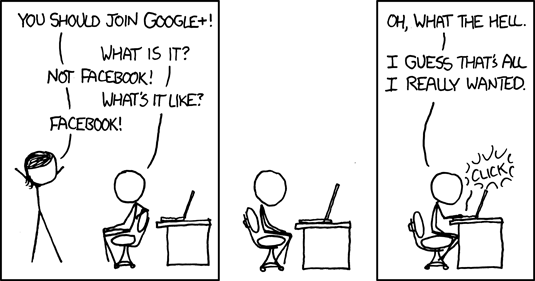
Google+ is Google's new social networking site. Google released this in the summer of 2011, and so far, it has picked up a lot of users. However, it seems to have lost some of the early momentum.

Spot on, xkcd!

I feel like Google versus Facebook will be a tremendous battle. Facebook has already reacted and quickly started to implement some of the features Google+ offered. Competition is usually a good thing for consumers, after all! Now that Google+ is a few months old, it is less of a novelty.

As it becomes less of a novelty, people start to take a more critical eye to it. One of Google's engineers, Steve Yegge, accidentally (?) posted a rant about Google+ last month. To summarize his complaints, Google+ does not make it easy for other people to create Google+ apps, therefore making it difficult for app developers to create Google+ apps. This is certainly a current limitation of the system.

Will Google+ adapt or die? We shall see.

Also, I have a Google+ profile set up, if anyone would like to add me.

Friday, September 09, 2011

Monetizing a Site

As some of you know, I teach courses that involve Web 2.0 technologies such as blogs, social networking, and other such material. For me, it is critical to be involved with some of these because it keeps me up to date on the stuff I am teaching. After all, if I am not staying involved with these things, how can I speak to their effectiveness, ease of implementation, and details?

I'll definitely talk about this in my Internet course this semester, but I felt like it might be a good idea to put some information out about how people make money off of Web sites, even if they are not selling products or services online. Here are three ways a Web site can make money with no risk, and links to sites I have personal experience with.

Advertising: Google has a program called AdSense, which allows a Web site owner to sign up and set up an account to display ads. Through a pretty straightforward step-by-step process, they are given the option to choose how invasive they want the ads to be. For example, you will notice I have a few small ads on this site. Through Google's Blogger service (which hosts my blog for free), it is even simpler. For other sites, Google will give you some HTML code that you embed in your Web site. If you don't know what that means, your Web developer will.
From my own experience, I've been running this blog since 2006. Google will send you a check after you make $100, and I haven't received a check yet. If I were being paid by the blog post, I'd probably be making about 20 cents a post. If my goal was to try to make money, I could choose to display more ads, or make the ads more prominent. I am also displaying blog entries in my Facebook account, so I assume many of my students are viewing this through Facebook and don't even see the ads, which also cuts down on possible ad revenue. In terms of keeping myself fresh with the technology, I will usually hop on and change the format a little bit before I talk about it in class. This way, I can speak about the latest version of Google AdSense from my own personal experience.
Is Google the only site that allows you to advertise? No. However, Google is pretty trustworthy. There are other, less ethical sites that allow users to display ads and may pay more. However, some of them use some shady business principles.
In general, if you are a small Web site, Google AdSense allows you to easily connect with advertisers without having to worry about doing much work.

Affiliate Marketing: Sites such as Amazon and Walmart offer affiliate marketing. Affiliate marketing basically allows me as a Web site owner to provide links to Walmart or Amazon. If anyone clicks on those links and buys something, I get a small percentage of that sale. Amazon Associates is among the most popular. Users can log in and get a personalized link.
Users can link directly to a product, or just to the main site. Amazon requires a minimum payment of $100 before they will pay you. Again, I may reference it once in a while, but I've never received a check from them because I really don't push for clicks. I have a small link on the right hand side of my blog, and will once in a while go and build a link to stay on top of things.
Sites that really want to monetize may even ask their users to click on the Amazon link they have provided if they are going to buy something anyway, as it will help support them. The more a user sells, the larger a percentage of fees they get.
As a member I see (sometimes on a weekly basis) how they are changing the program. Amazon and some states are in court because of Amazon Associates. The short form is that states are suing them because states feel this program should compel Amazon to charge sales tax. Looooong story there.

On-Demand Publishing: Sites like CafePress allow users to upload a logo. Once the logo has been uploaded, you can decide what you want it to be on. Do you want it to be on t-shirts? mugs? underwear? You then choose how much markup you want to ad and provide your users with a link to the site. This is a great option for a company that does not want to risk buying t-shirts and then having them not sell. As a matter of fact, one of my students last semester mentioned he set up a site like this for one of his high school organizations. I've got a small site on there I haven't played with in a few years, but it's kind of a neat way for Web site owners to create shirts with no overhead, or for artists to make logo shirts, mugs, and other items.

If you have a Web site or are an artist of sorts, these are some options available to you.

Saturday, February 26, 2011

Stalking? There's an app for that.

A large part of Facebook's appeal is the ability to add apps to your account. Games (such as Farmville or Vampire Wars), social apps (like Yelp or horoscope apps), self improvement apps (dieting apps, investing tips) and many more can be found on the site, many of which are free.

There are times where Facebook will determine that certain apps violate their terms. For example, in early 2009, Burger King created an app that, if you dumped 10 friends, would give you a free Whopper. Really. Facebook's rationale was that apps are not allowed to tell people if you've dumped them as friends, and this app did.

Facebook just pulled the plug on an app that many contended was a stalking app. Breakup Notifier was an app released recently. The whole purpose of the app was to let you know if someone's Facebook relationship status changed. For example, if someone was listed "in a relationship" and changed their status to "single", you would be alerted.

Many people view this as a stalking app, but in my opinion, if someone puts this information out there publicly, there really isn't anything wrong with it. I could just as easily bookmark a profile and revisit it to see if someone changed their profile status, and I would also be able to see it through my News Feed. This app would just monitor it for you and send you a response via e-mail when that status changed, providing you with real time information.

Facebook has apparently permanently disabled the app, citing some reason or another. Was it the 3.6 million users it amassed in a week (and the strain it added to their servers), was it complaints, or was it something else? I would guess complaints. I am assuming that the same people who post their relationship status publicly are the same people who wrote to Facebook to complain.

Undeterred, the creator of the Breakup Notifier has created another app, Crush Notifier. This works very much like speed dating. Let's say Sally has a crush on Tim. She would mark that she has a crush on him, using this app. Tim would not receive notification of Sally's crush, so Sally does not risk rejection or awkwardness. However, if Tim marks through the app he has a crush on Sally, they would both receive e-mail notifications that they like each other. Crush Notifier even has a business model, where you get two uses for free, and would need to use Facebook credits to receive any further e-mails.

Amazing how social media continues to change society, huh? Well, as Ricky Bobby said, "Does that blow your mind? That just happened!"

Friday, October 29, 2010

Death by Farmville

Wow.

We've seen this story on the news before...a parent shakes a child and it dies. Sad, unfortunate, but also not uncommon. This happened down in Jacksonville, Florida. What makes this sensational is the fact that the mother got upset with the child over it interrupting her playing Farmville.

Facebook's role is being overblown in the media. Notice it is not "Mother Shakes Baby to Death". Headlines seem to be more "Child Dies due to Facebook Game". The focus is put on Facebook. News articles do report she was playing it through Facebook, but Facebook did not create Farmville. You don't have to be on Facebook to use Farmville (Myspace and Twitter also work, as I understand). Putting Facebook in the headlines is sexier than putting Farmville in the headline.

Of course, this is also going to be something people cite when they say Facebook is bad for society. I have a friend who hates Facebook, and I am sure this friend will see this headline and just tie it to Facebook.

Let's be honest. If this woman would shake a baby to death over a Facebook game, she probably have done it over a TV show, or cooking, or a phone call, or any of another thousand reasons.

Link to CBSNews Article

Friday, October 15, 2010

Stalking a criminal

The Internet has obviously changed many things. One thing it has changed is crime. Criminals are known to use sites like Craigslist and eBay to sell stolen goods.

It's interesting how people have also used this in the investigation of crimes. For example, a woman recently had a GPS stolen, and used Craigslist to get in touch with someone who was selling a GPS of the same brand the next day. She contacted the guy, got his email address, used that to find his profile on an online dating site, used that information to find him on Myspace....

The police were able to get video footage from a McDonald's where he used her card, and the Myspace profile matched the face of the person on the video.

It's a lesson that (as she says) you never know who you are robbing.

Link to story

Saturday, July 17, 2010

How Old Spice just changed social networking

I was watching the baseball All-Star game the other night and there was an Old Spice commercial that came on. This commercial featured a good looking guy basically telling women that their man doesn't look like him, but they could smell like him. It was really over the top and goofy.


So yeah...amusing enough, I chuckled. Were this the end of it, that would have been enough, but the commercial producers arranged for their Facebook, Twitter, and Reddit sites to allow people to tweet/post questions. The actor, a former NFL hopeful named Isaiah Mustafa, then posted an incredible amount of responses...all of which were done in a towel in his bathroom as if he had just left the shower. Some of them were to famous people, and some to random people. Some of the celebrities he tweeted videos to include Demi Moore, George Stephanopoulis, Ellen Degeneres, Rose McGowan, Ashton Kutcher, Ryan Seacrest, Starbucks, and perhaps most famously, Alyssa Milano. Alyssa Milano went back and forth, with the actor posting four videos flirting with her, and even sending her flowers in real life, and prompting Alyssa Milano to post a video response in a towel of her own (view the entire set of videos here).

Apparently, he responded with over 180 videos over a few days, and had 5.9 million video views in the first day, according to this article. The amazing part is that this is getting news coverage, and celebrities are basically giving Old Spice free advertising. This is just one of the most amazing Internet buzzes I have seen. Sadly, the videos seem to be done for now according to the Twitter feed, but I wouldn't be shocked if Old Spice brought them back based on the popularity.

The question for Old Spice is always "will this improve sales" and the answer isn't clear at this point. If nothing else, they generated buzz!

The actor, based on this, was signed to a deal with NBC, who hope to capitalize on his buzz and create a sitcom.

Check out the tweeted video responses here:
http://twitter.com/oldspice

Friday, May 21, 2010

Everybody Draw Mohammed Day

Facebook certainly has had its share of controversy, and another round of controversy has come up recently.

The entire Facebook site was banned in Pakistan due to a Facebook user creating a group called "Everybody Draw Mohammed Day".  Images of the prophet Muhammed are considered offensive by many people of the Muslim religion, as shows like South Park have shown lately.  I think every group has the right to their own beliefs, and if they believe that an image of Muhammed are offensive, I don't think I have any right to tell them otherwise.

Facebook was blocked in the entire country of Pakistan as a result of this controversy.  The offensive page has been removed.  No one is quite sure whether Facebook removed it, or whether the creator did, or whether it was hacked and taken down.

Sites like Facebook present such interesting problems for governments.  In the United States, we enjoy a freedom of speech, but in other countries, this is not necessarily the case.  In a country where that is not the case, how does a government deal with a site that is based in the US (and therefore a site they have no jurisdiction over)?  Worse yet, how does a government deal with a site that contains offensive material posted by a user, as was the case here?  In Pakistan's case, they chose to simply shut off access to Facebook.   Fascinating.  One person posts something offensive, and it causes an entire country to block access to the entire site.  Think of all the losers here.  Advertisers could not get their message out, so they lose.  Facebook could not display the ads, so they lose revenue there.  People around the country who had nothing to do with this and no knowledge of it could not access the site. 

It makes me appreciate our freedoms just a little more when I read things like this.

Tuesday, March 09, 2010

Other uses for Facebook

We've been discussing Facebook, Myspace, and Twitter in my CIS 101 classes recently, under the guise of social networking.  Business folks refer to the collection of technologies like social networking, wikis, etc. as "Web 2.0" content - more interactive Web pages.

Aside from the obvious uses, there are other things that these sites are used for.  One thing that you have seen in certain areas is police departments asking for help.  For example, in the link below, a New Zealand police department caught a thief by posting a security image on Facebook.  This is an article from last year, but it's still an interesting application of social networking.

Link to Story

Saturday, October 03, 2009

Twitter and the NFL

...Twitter strikes again!

Jets wide receiver David Clowney (and come on, that's an awesome name for a football player) was benched after tweeting ("Twittering") something about being unhappy with his playing time.

It's a fascinating thing to see this develop. In the past we've seen a soccer player fined for Twitter comments, a NBA player benched for it, and the NFL create rules to try and proactively prevent problems (my past thoughts appear here). It is certainly a change in the way we communicate. Now we can post our thoughts and have hundreds or thousands of people see the thoughts immediately. There are consequences to this, as people are learning, and you will likely see problems like this continue to arise as these social networks evolve. There is no filter if you are just upset, or drunk, or whatever, and that's going to lead to some issues in the next few years for some celebrities, I imagine.

Link to story

Thursday, October 01, 2009

Ride the Wave

Yesterday (9/30/2009), Google released a new product, Google Wave, to 100,000 testers. Basically, this is Google's way of trying to bring together word processing, instant messaging, social networking, blogs, and directions. For example, in a video, they allow you to have a conversation with someone through chat, and have it autopublish to a Web site. (I can see this being extremely useful in technical support, for example - you could have chats published, and then when people search for that problem, it shows up.

It is a technologically interesting tool, but I am not 100% sure of whether this is really going to take off. Time will tell, as will the 100,000 beta testers (not counting the ones who sold their invite on eBay!)

Google Video on Wave
CNN Story

Saturday, September 05, 2009

NFL bans use of Twitter on Game Days

The NFL has become the first league to really take a stand on social networking. News has broken today that the NFL is banning players from Twittering (and Facebooking, etc) for communications purposes on game days. This ban starts 90 minutes before the first game, and ends after the post-game interviews. This idea makes sense. This way, you avoid people getting upset and saying something they later regret. The league will likely back this up with fines or something like that.

It's rather amusing to me that we literally JUST talked about Twitter and sports two days ago in my Internet/E-Commerce Technologies class, and our discussion already is somewhat out of date.

Link to Article

Saturday, July 18, 2009

Site Navigation and other Goodies

(If you are viewing this from Facebook, you'll need to visit profcameron.blogspot.com to see the things referenced in this post)

I notice some interesting Google searches that end up on my little blog, for example, in the last week, I've had some of the following:

"email hoaxes personality types"
"i am an employee i want free resumes database of employes jobs of biometrist in newzealand"
"how to attract professor"
"she-goat, wolf and cabbage download"

I am not even sure what some of those folks were looking for, but they put those terms in to Google and found my site.

Anyway, just for reference, I wanted to mention some of the things I have set up through Blogger:

1) Email updates: Google's Feedburner service allows you to get my posts via email. It's free, and if you enter your email address in the box over on the left hand side, you can add (or remove) your email subscription. I've copied it here. If you enter your email and then click "subscribe" you will get my posts via email. Feedburner is spam-free, and I don't even see your email addresses without looking really hard to find them.


2) Site search: Up at the top left corner, there should be a text box from Blogger that says "Search" next to it. If you are looking for a keyword from a prior post, you can use that to search.

3) Labels: At the end of each post, you will see an area that says "labels" - these are little keywords I attach to each post. For example, I will label this post with keywords like "Google". If you want to search all things related to one of MY labels, there is a list of labels along the left hand side of the screen, typically about a screen down from the top of the page. Clicking on a label shows you all posts I gave that label to.

4) Facebook updates: I created a Facebook account, and set it up so my blog shows up there as a "news" item. Posts from my blog show up on my wall in Facebook, so you don't need to even remember my Web site address of profcameron.blogspot.com to get here. You can add me at any time.

I'll be posting my Fall 2009 schedule next week, and also discussing jury duty (I got selected for jury duty for the first time, and it's been an interesting experience - but I am not supposed to really discuss much until the trial is over - better safe than sorry).

Friday, July 17, 2009

MLS fines player for Twitter comments

We all have a lot of thoughts throughout the day - some good, some bad. I am sure we wouldn't want everyone seeing every one of them (...or is that just me?).

After a tough loss, a Major League Soccer forward for the Houston Dynamo, Brian Ching, posted a reaction to a referee's call on his Twitter account:

"Ref in seattle just cheated the dynamo, What a joke. Not even close. Ref is a cheat."

Facebook and Myspace and Twitter and all the social networking apps and blogs have broken down barriers to some professional athletes. It used to be that you didn't really get to see much of a player's personality unless they got a job as a commentator or wrote a book. Now, athletes Twitter (and get themselves in trouble for doing it) during games sometimes.

The interesting part is that Major League Soccer actually FINED Ching for this. Fairly or unfairly, we've certainly seen people lose jobs over actions described on sites like this (a few). This is the first person that I've heard of actually fined over this. Of course, I am sure his contract with MLS says something about not being able to comment publically in a way that damages the league, but it's still an interesting decision, and something I am sure we will see more of in the future.

Link to CNNSI article

Brian Ching on Twitter

Monday, March 23, 2009

Twitter in the NBA and poor netiquette

Twitter is one of the social networking applications for the Internet - you have the ability to post status updates from mobile devices, etc. Before Facebook and Myspace had mobile applications, this was THE mobile social network. According to Wikipedia, it's still the third most common social networking application, ahead of sites like Friendster and HI5, and behind only Facebook and Myspace.

One of the issues I find in the classroom sometimes is poor etiquette. For example, there are times I am in the middle of teaching a lesson, and I see a student texting or doing something on their phone. It becomes distracting, and it is a little frustrating to deal with. As such, it causes me to lose focus, and therefore, affects the learning environment for the entire class.

I (and many professors) feel like it is rude when students do that ... and that the class isn't important to them. This is why this article was something I can relate to:
http://sports.espn.go.com/nba/news/story?id=3990853

Basically, a player from the Milwaukee Bucks basketball team, Charlie Villanueva, updated his status on Twitter during halftime of a game. His coach, Scott Skiles, got pretty upset about it, and, much like some students may think, he didn't think it was a big deal. The coach, on the other hand, felt like it showed a lack of focus on the game by the forward.

On some level I can relate with Coach Skiles.

Monday, October 06, 2008

How to turn the tables on human resources

What you have on your Myspace or Facebook, someone can find easily.

Try this. Log out totally, search for your name. See what information you can see about yourself.

This information can be used in electronic warfare, as David Csuha discussed recently in his Security Sense blog, but also can be used in scenarios such as job hires, and often is! According to recent estimates, 20% of companies use social networking sites like Myspace or Facebook as part of the hiring process.

For example, put forth a cover letter saying how responsible you are, and a company may check up on you - Googling your full name in quotes may lead to pictures of you falling down drunk because someone tagged a picture with your full name on Facebook.

If you are job seeking and this is your Myspace picture, change it.

What happens if interviewers search Myspace - will they find a public blog you wrote saying "hey, I'm at work and it sucks here, but it's nice to be paid to hang out on Myspace instead of working"?

What sort of comments are your friends leaving you, and what do those things say about you?

Here are some examples of what can happen:
What's interesting is that you could even turn it in to a POSITIVE. If your Myspace or Facebook are well written, and you have a blog that details that you are really hopeful that your interview with company X goes well, and that you are excited about getting a chance to work with that company, it might be a good idea.